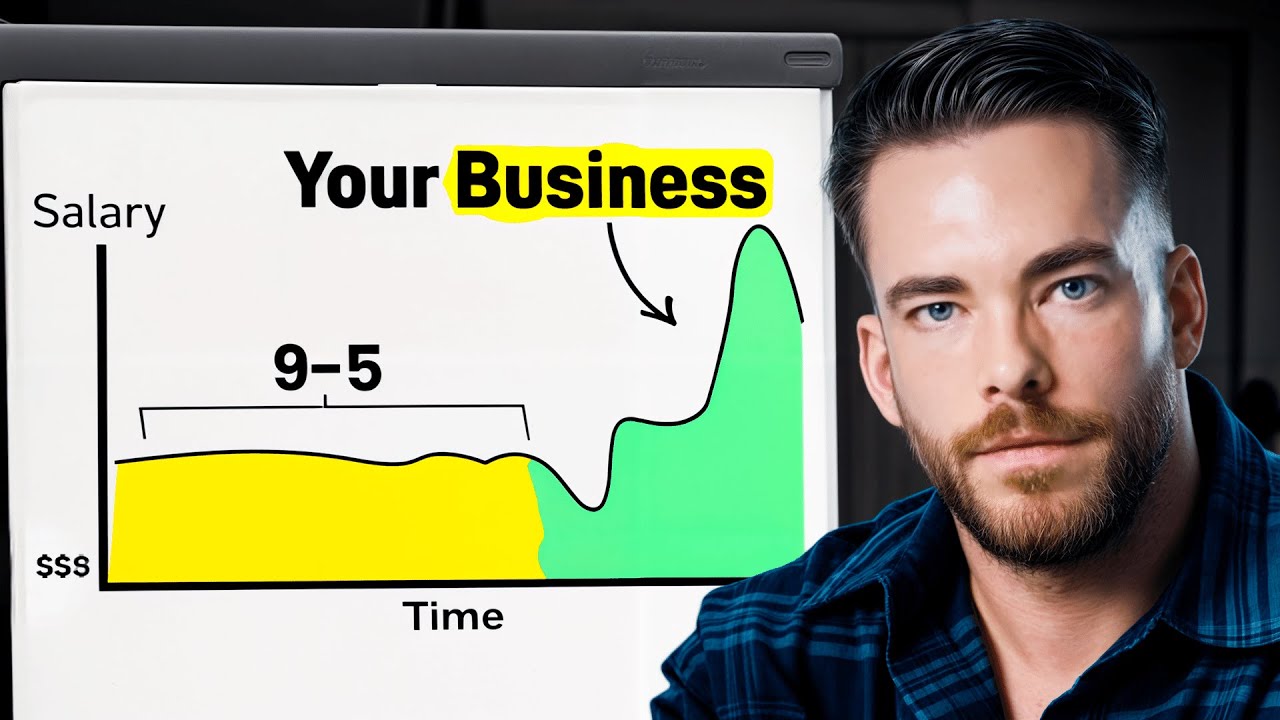
My first two years in business brought in about $2,000 total. I almost quit five times.
The next six years brought in about $115M. If I had taken a $100K a year engineering job instead, I estimate it would have cost me about $14.4M in lost opportunity.
Here is the three level blueprint I would follow to build a $1M business: develop yourself, get customers and close them, then scale with leverage.
Level 1: Develop yourself first
Personal development has four parts: knowledge, skills, motivation and environment.
- Knowledge and skills. Traits are really bundles of skills. Sales is active listening, eye contact, body language and objection handling. Marketing is paid ads, copywriting, social media and websites.
- Motivation. It comes from lacking something. Surround yourself with people who earn more than you, or pick role models. Mine included Gary Vee, Andy Frisella and Ed Mylett.
- Environment. It either helps your goals or hurts them. Filter everything by whether it moves you closer or further away.
I moved home and stopped dating, drinking, partying and seeing friends. I worked 16 to 18 hours a day in a small room at my parents’ house while family, a girlfriend and my own head doubted me.
Choose who to sell to and what to sell
Most people want to sell something cheap to a lot of people. Selling something expensive to fewer people is usually easier. Big deals can be split into payments, like a 12 month service billed monthly.
Your buyer is usually someone with the same pain you had, someone who shares your passion or someone who needs your professional skills. Start with the smallest, highest paying niche you can serve, then expand. Mine was fitness. I could also play piano, type around 100 words a minute and sell door to door, but fitness was where I added the most value.
Qualify buyers on three things: a big problem you can solve, money to spend and urgency.
The ideal product is unique, expensive, sticky and cheap to deliver. It doesn’t need all four. Protein bars, ads and books scale easily but often need more capital. Consulting, law and accounting are easier to sell but harder to deliver well at scale.
Level 2: Get found
There are four lead sources: warm outreach, cold outreach, content and paid ads.
- Warm outreach: about 100 DMs a day to followers, around 20 an hour to avoid spam blocks. Expect about 30 replies, about 5 calls and 1 to 2 closes. On a $3,000 product, 5 hours of DMs and 5 hours of calls is about $300 an hour.
- Cold outreach: same 100 a day to strangers, about 10% replies, about 3 calls and roughly 1 close. Warm and cold together made me about $50,000 a month before I ran a single ad.
- Content: use it to show relevance, not to chase virality. I’d rather be a business owner who learns content than a creator who learns business.
- Paid ads: about $10 a lead in B2C and about $20 in B2B. Use the law of 10: about 10% of leads book and about 10% of calls close.
Know your KPIs so you can tell whether you’re on track or underperforming.
Close them with IDSPOCCO
- Intro. Set expectations: goals, struggles, past attempts, then a yes or no.
- Discovery. Quantify the cost of the problem. Six months stuck at $20,000 a month is about $120,000. Get them to commit to moving forward today and confirm it’s a priority.
- Summary. Recap and get confirmation.
- Pillars. Three reasons to work with you, framed as “most people do X, we do Y.” Typically the offer fix, lead generation and an authority statement. Research pain points through competitors and Facebook groups.
- Overview. Five minutes or less on deliverables.
- Certainty. “Sounds pretty good” isn’t enough. “How do I sign up?” is.
- Close. State the price directly.
- Objections. Price, spouse or partner, time and belief. That’s it.
After the close, send a personal welcome video, onboard within 24 hours and book the next call right away.
Get more out of every customer
There are eight levers: raise price, lower cost, increase frequency, increase quantity, add services, raise quality, create scarcity or lower quality to sell more.
Start with price. I went from $1,500 to $2,000 to $2,400 to $2,800 to $3,200. Raise about 20% every three to five sales until objections climb, then settle. I settled at $3,200, about $800 a month over four months.
Hire people who can grow the business
Your growth is capped by the combined knowledge of your team. The most valuable skill is getting others to do the work.
Filter hard on the application: past business ownership, ads, sales, funnels and automation, and the type of clients they’ve worked with. My interview covers:
- Company values and standards. Don’t try to be liked by everyone.
- The role, the problem it solves and a realistic day.
- Past roles and daily tasks, not “have you done X?”
- What success means to them. “Lots of time off” is a red flag.
- A stress test, like writing an ad or recording a practice call. Hire sevens and train them into tens.
- Aligning their goals with the company’s.
- Desired salary, which tells you how to structure KPI bonuses.
- What working from home means to them.
- CEO sign off on every hire.
When someone underperforms, it’s one of five things: they didn’t know what to do, how to do it or when, they lack motivation, or something is blocking them. SOPs with a task, a video, steps and links fix the first two. Deadlines fix the third. Tying work to company growth fixes the fourth. The CEO decides on blocks.
Acquisition, delivery and operations have to scale together. Under about $100K to $300K a month one person may run all three. Above that, put a leader over delivery and operations and let the CEO own acquisition.
Level 3: Leverage, persistence and focus
Output equals leverage times volume. Leverage comes from your brand and your people. Volume is the work: I knocked 100 doors a day, about 21,000 in nine months. Online, 100 DMs a day is 36,000 a year.
Expect the phases: uninformed optimism, informed pessimism, the valley of death where most people quit, informed optimism and then the goal. Regret comes from lack of effort, not lack of achievement.
And don’t diversify too early. Most millionaires build other income streams after they become millionaires. Stay on one business until you have people who can run something else.
The takeaway
Become the person first, then get customers, then build leverage. Either you sacrifice for your goals or your goals become the sacrifice.
Want to know what’s capping your business right now? Take my free 90 Day Ceiling Plan. Answer 18 questions and get a written plan, built on your own numbers, that names the one thing holding you back and what to fix first.